


👀 “Phak Kat Hua” (literally “head cabbage”) — have you ever heard of this name? Many people might think of leafy vegetables with green and white leaves. But did you know that this vegetable actually has another name that we are all very familiar with? Curious what it is? Today, the Science Library of the Department of Science Service has the answer for you 🔎
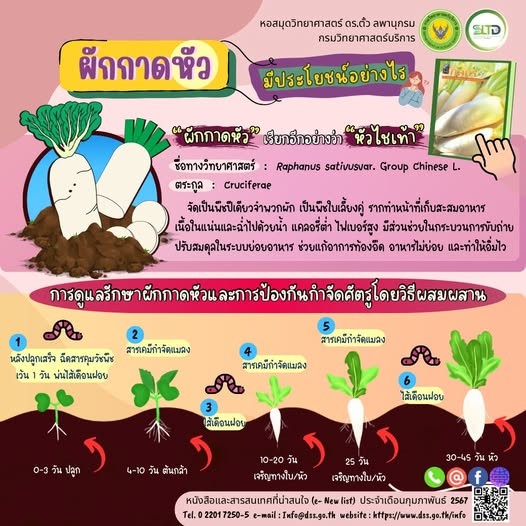
🥬 “Phak Kat Hua,” also known as “radish” (daikon), has the scientific name Raphanus sativus var. Group Chinese L. It belongs to the Cruciferae family and is classified as an annual dicot plant. Its root functions as a storage organ and typically has a large, elongated cylindrical or round shape. It is usually white (though other colors exist), with firm, juicy flesh.
The root can be used in a wide variety of dishes, both savory and sweet, such as clear radish soup, mixed vegetable stew (chapchae-style), oden, radish kimchi, fried radish cake, and sweet preserved radish.
🥬 Benefits of radish
✨ Low in calories and high in fiber, helping support digestion and bowel movements
✨ Helps balance the digestive system and relieve bloating and indigestion
✨ Contains compounds with anti-tyrosinase activity, which play a role in inhibiting melanin production in the skin
🥬 Modern production technology
Currently, integrated production technology is being developed to produce safer radishes. This includes using fertilizers based on soil analysis combined with biofertilizers. Continuous monocropping and long-term use of high fertilizer rates can lead to excessive accumulation of phosphorus (P) in the soil.
It is recommended to apply phosphate-solubilizing biofertilizer at a rate of 50 kilograms per rai before plowing and bed preparation.
Additionally, biological control methods are used to manage pests. For example, Thai strains of entomopathogenic nematodes are applied to control caterpillars and flea beetles at a rate of 8 packs per rai, mixed with 20 liters of water in a backpack sprayer. Spray every 5–7 days:
- 1st application: after planting
- Then apply herbicide the following day
- 2nd application: at 15 days
- 3rd application: at 20 days
- 4th application: at 25 days
- 5th application: at 30 days
If pest outbreaks are severe, chemical pesticides may be used.
📖 For those interested in more details, please refer to the journal article:
“Integrated Production Technology for Radish Toward Safe Crop Standards,” Kasikorn Journal, 2023, Vol. 97(1), October–November, pp. 17–24. clickhere
You can also follow recommended books and information (e-New list) for February 2024 at:
https://www.dss.go.th/a/qr/E2Xqt
or access services via the “Information System of the Department of Science Service.” clickhere