

Have you ever wondered… what kind of scientific processes are hidden behind that smooth, flavorful glass of wine we enjoy sipping? 🤔 Today, STLC is here to unlock the chemical secrets hidden inside your wine glass!
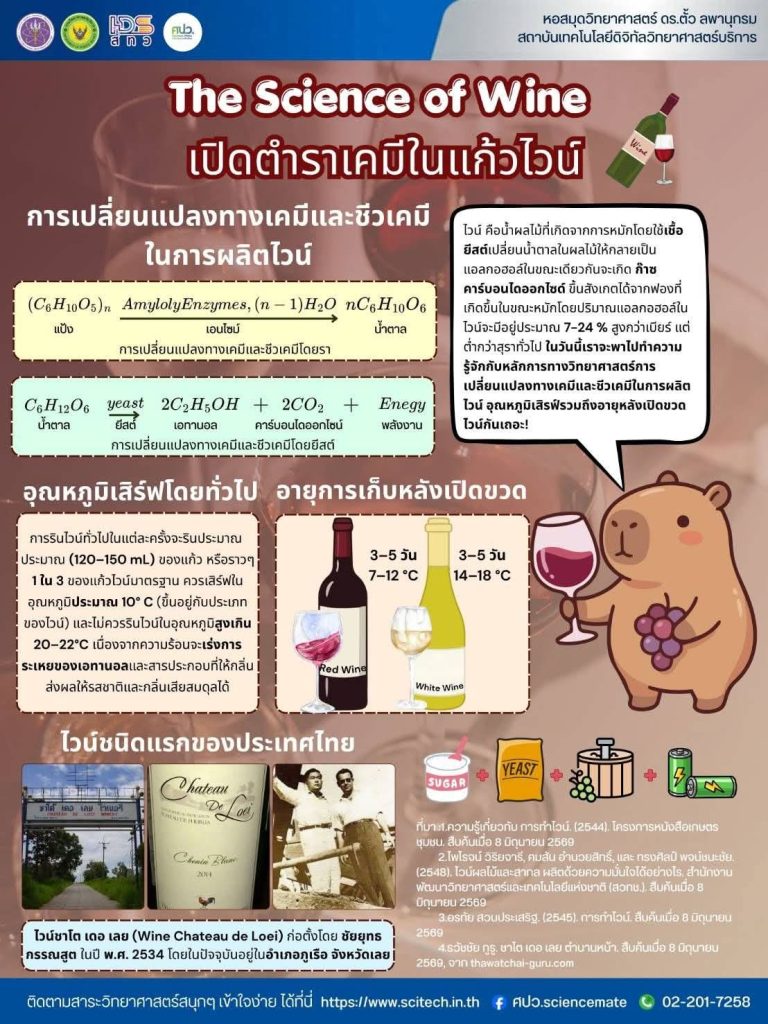
🔬 Chemical and Biochemical Transformations in Winemaking The heart of winemaking is “Fermentation,” where our main hero, “Yeast,” takes charge of converting the sugars in fruit into alcohol (ethanol), carbon dioxide gas, and energy. Generally, wine contains an alcohol content of about 7–24%.
🔸 Starch ➡️ (Enzymes) ➡️ Sugar
🔸 Sugar ➡️ (Yeast) ➡️ Ethanol + Carbon Dioxide + Energy
🌡️ Serving Temperature… A Small Detail You Shouldn’t Overlook A proper pour should fill about one-third of the glass (120–150 mL). Most importantly, wine should never be served at temperatures higher than 20–22°C because the heat will accelerate the evaporation of ethanol and aromatic compounds, causing the wine’s flavor and aroma to lose their balance.
⏳ Shelf Life After Opening Whether it is Red Wine or White Wine, once the bottle is opened, it should be consumed within 3–5 days while stored at the appropriate temperature for each type to preserve its optimal flavor.
🇹🇭 Did You Know? The First Wine in Thailand… …is “Chateau de Loei” wine! It was established in 1991 (B.E. 2534) by Mr. Chaijudh Karnasuta and is currently located in Phu Ruea District, Loei Province.
As you can see, science really is all around us—even in your favorite glass of drink! 🥂
📌 Follow us for more fun and easy-to-understand science content at: 🌐 Website: https://www.scitech.in.th
💙 Facebook: ศปว.sciencemate
📞 Tel: 02-201-7258
#STLC #ScienceMate #TheScienceOfWine #Science #Wine #WineChemistry #GeneralKnowledge #ChateauDeLoei #FunFacts