


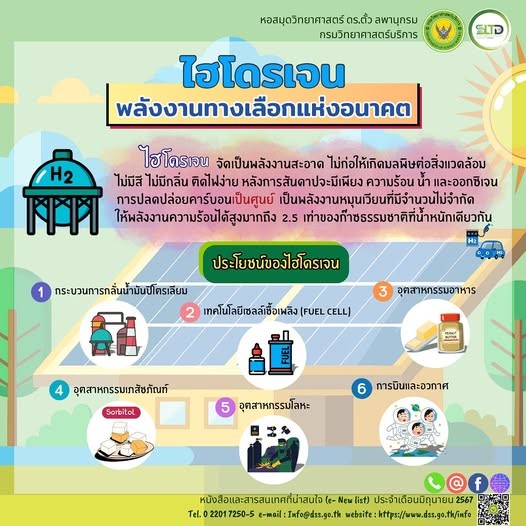
🌍 The rising global temperature has become a major issue today, prompting many countries to set targets for reducing greenhouse gas emissions into the atmosphere, or achieving net zero emissions, as these emissions are a key cause of global warming. The use of renewable energy, such as hydrogen energy, is one alternative to help reduce pollution on Earth. Would you like to know what hydrogen energy is and what its advantages are? Today, the Science Library of the Department of Science Service will introduce you to hydrogen energy 🙌🏻
💧 Hydrogen is the lightest element and a major component of water, which is abundant on Earth. It is also an important component of other compounds, such as hydrocarbons and petroleum products, which play a significant role in economic development.
The general properties of hydrogen include being colorless, odorless, highly flammable, and having a higher energy content than many other fuels. The byproducts of its combustion are only heat, water, and oxygen, with no release of harmful gases or toxic substances. Therefore, hydrogen is considered clean, non-toxic, and environmentally friendly.
💧 Current uses of hydrogen
- Petroleum refining: Used to improve the quality of crude oil for fuel production
- Fuel cell technology: Used to generate electricity; the outputs are electrical energy and water
- Food industry: Used in hydrogenation to convert unsaturated fatty acids in animal fats and vegetable oils into saturated fats, for products such as shortening, peanut butter, and margarine
- Pharmaceutical industry: Used as a raw material in the production of sorbitol, a sugar alcohol
- Metal industry: Used as a protective gas in welding processes, particularly in stainless steel production
- Aviation and aerospace: Due to its light weight and clean energy properties, hydrogen is used in fuel cells. Two commonly used types are Proton Exchange Membrane Fuel Cells (PEMFC) and Solid Oxide Fuel Cells (SOFC)
As you can see, hydrogen energy is not only versatile in its applications but also serves as an important alternative for helping to reduce global warming 🌱
📖 For those interested in more details, please refer to the academic journal:
“Hydrogen: The Alternative Energy of the Future,” Journal of Energy and Environmental Technology, 2023, Vol. 10(2), July–December, pp. 78–84. https://www.dss.go.th/a/qr/7xaQh
📗 You can also follow recommended books and information (e-New list) for June 2024 link, or access services through the “Information System of the Department of Science Service.” click